Launch offer — valid today only

📄 Digital book in PDF · read it on your phone or print it

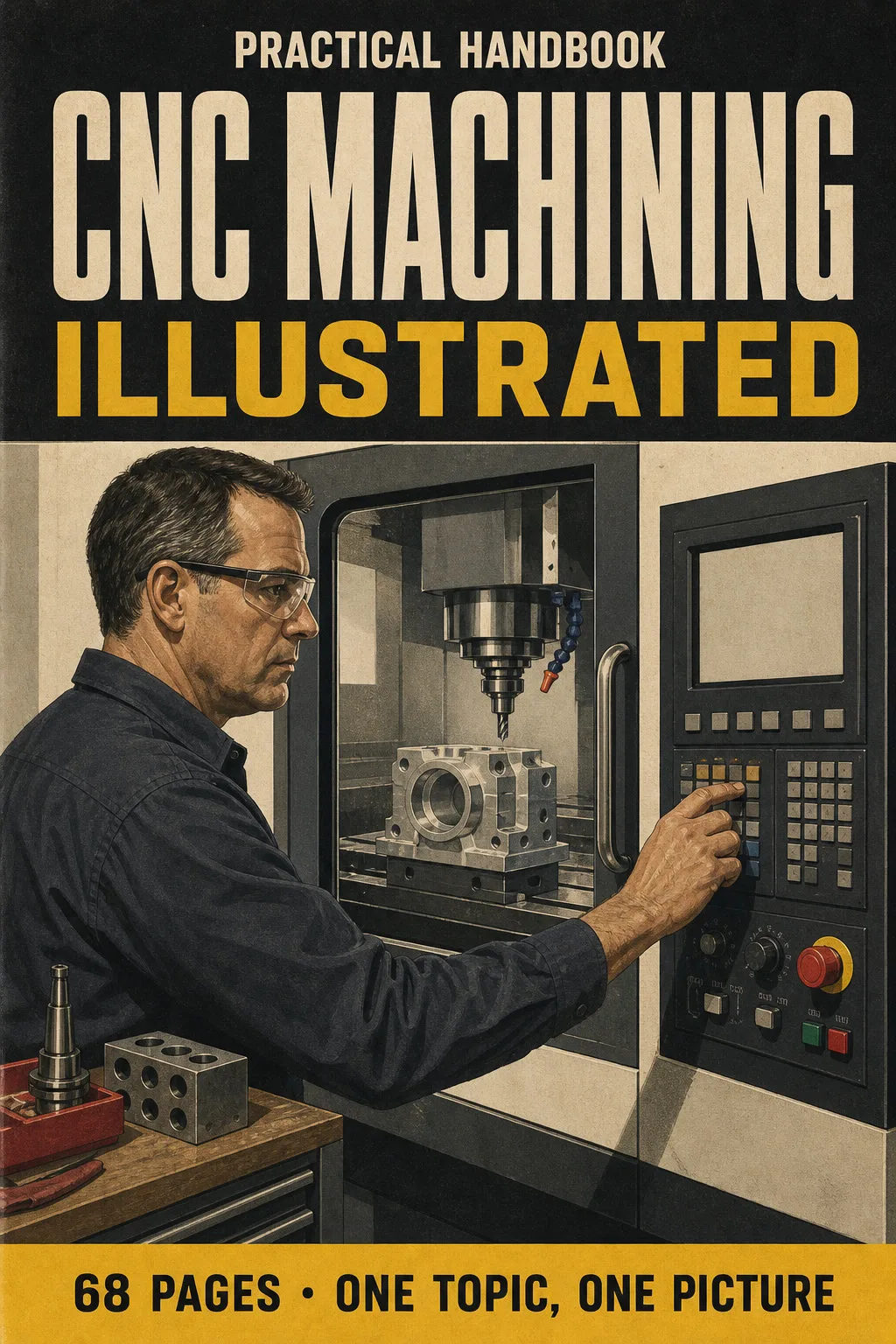
CNC Setup and G-Code, Illustrated: Know What the Machine Will Do Before You Hit Cycle Start One Topic on Every Page

For operators moving up to setups and adults in a machining program, mill and lathe. Work zero, tool offsets, G-code line by line, drilling cycles and SFM to RPM. Every topic gets its own page: the drawing first, then the numbers to remember. 68 illustrated pages.

START STUDYING THIS WAY

🔒 Secure checkout · PDF by email · 30-day guarantee
Every topic, its own pageEach setup step and each code drawn, with the explanation right beside it
68 illustrated pages9 parts, from the machine and its axes to the final review and quick check
Up-to-date sourcesChecked against ASME Y14.5-2018, OSHA 29 CFR 1910.212 and the NIMS Level I machining skill standards
PDF by emailFormat

Look Inside the Book

Every page has one big drawing and a box with the codes, numbers and steps you need to know:

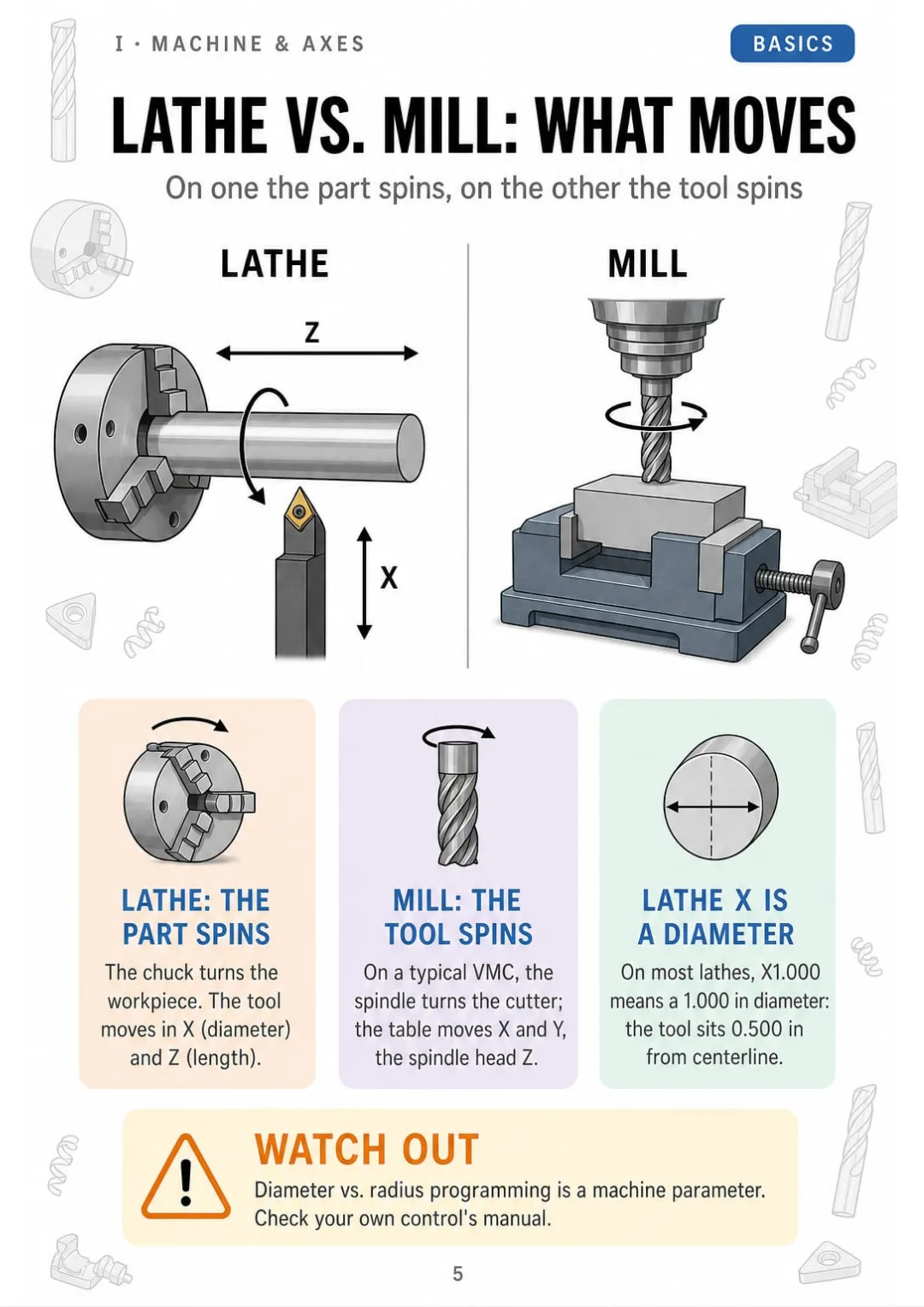
Lathe: part spins, X is a diameter. Mill: tool spins, table moves X/Y.
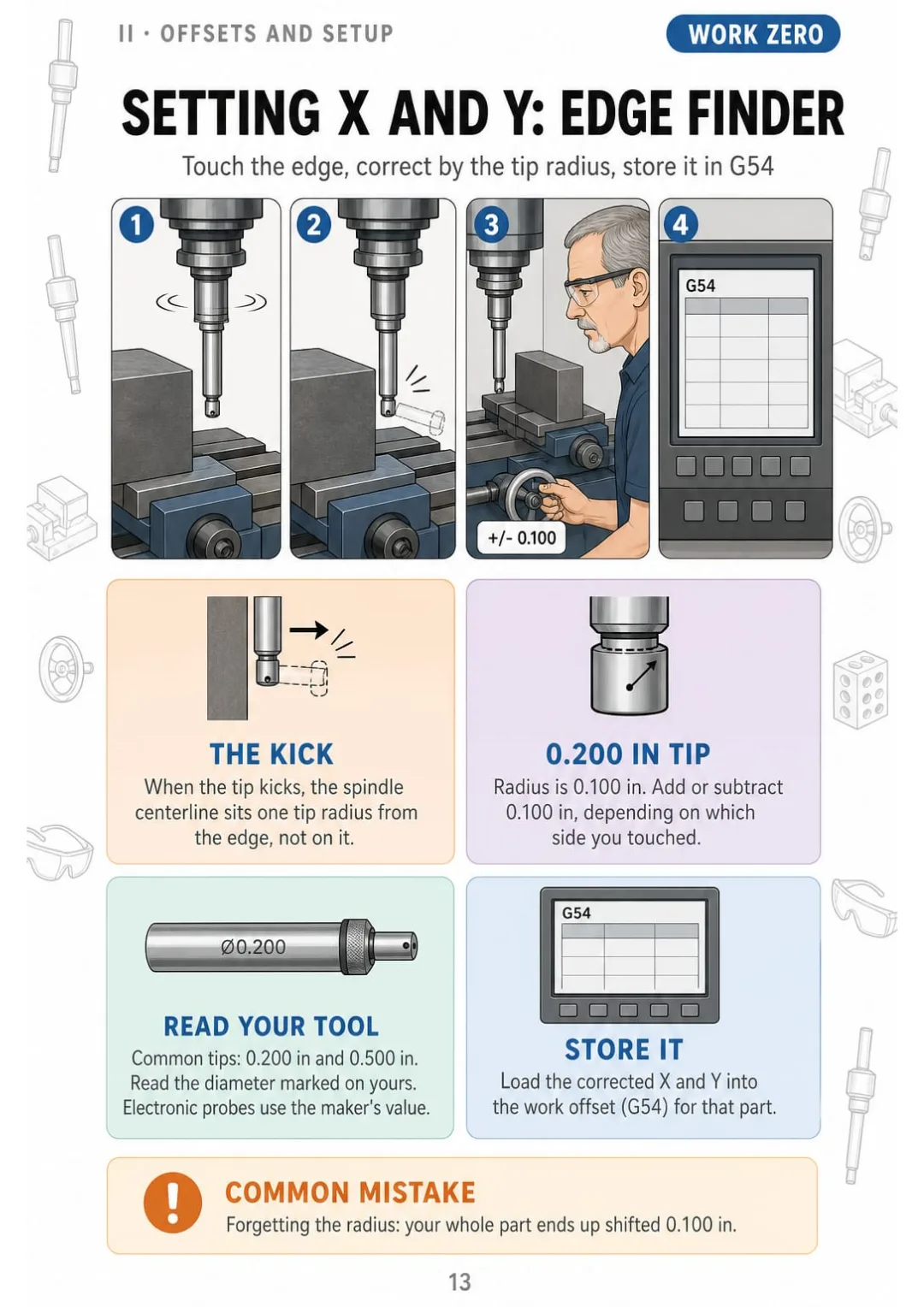
Edge finder with a 0.200 in tip: the spindle is 0.100 in from the edge when it kicks.
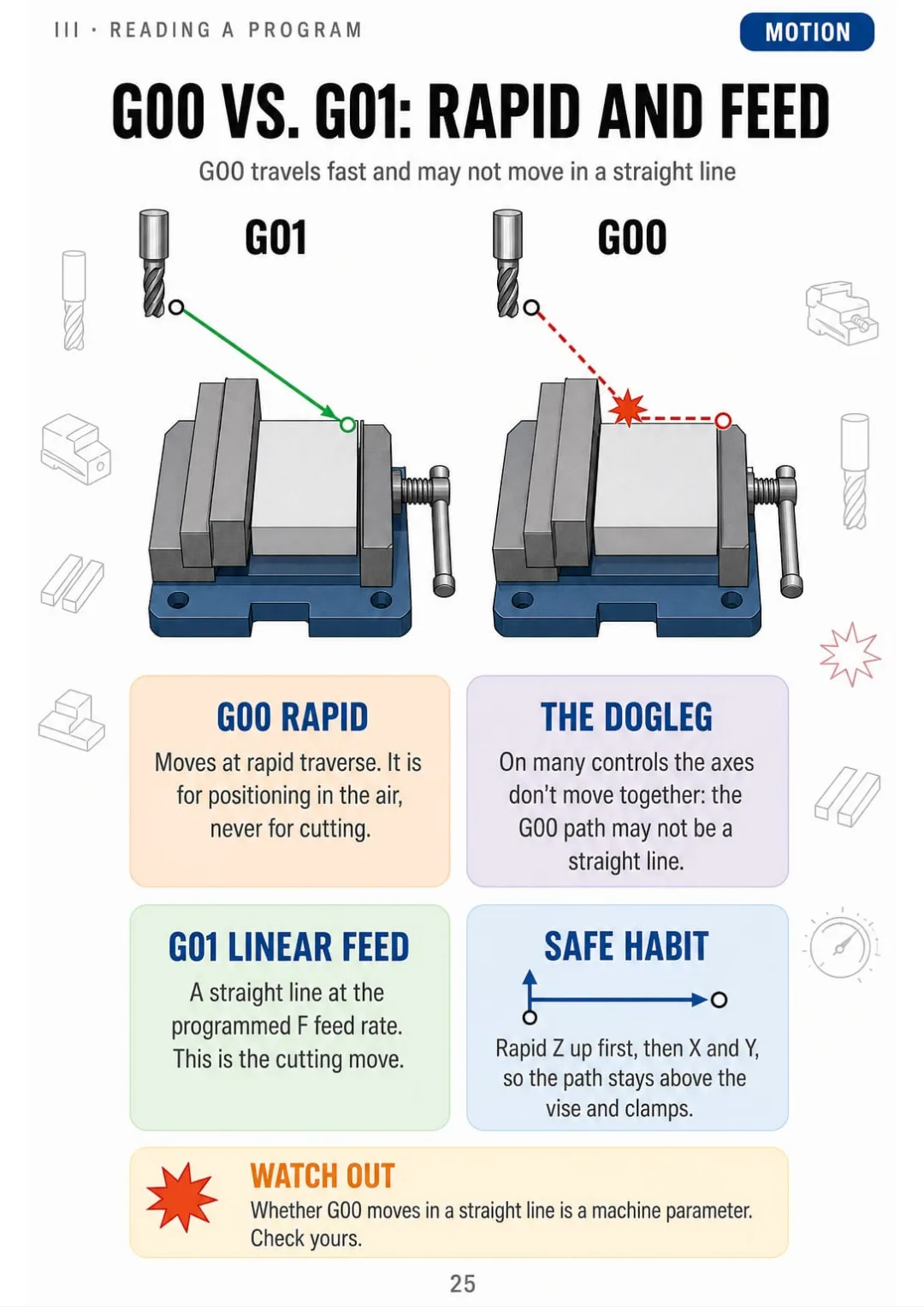
G00 = rapid, may be a dogleg; G01 = straight line at feed F.
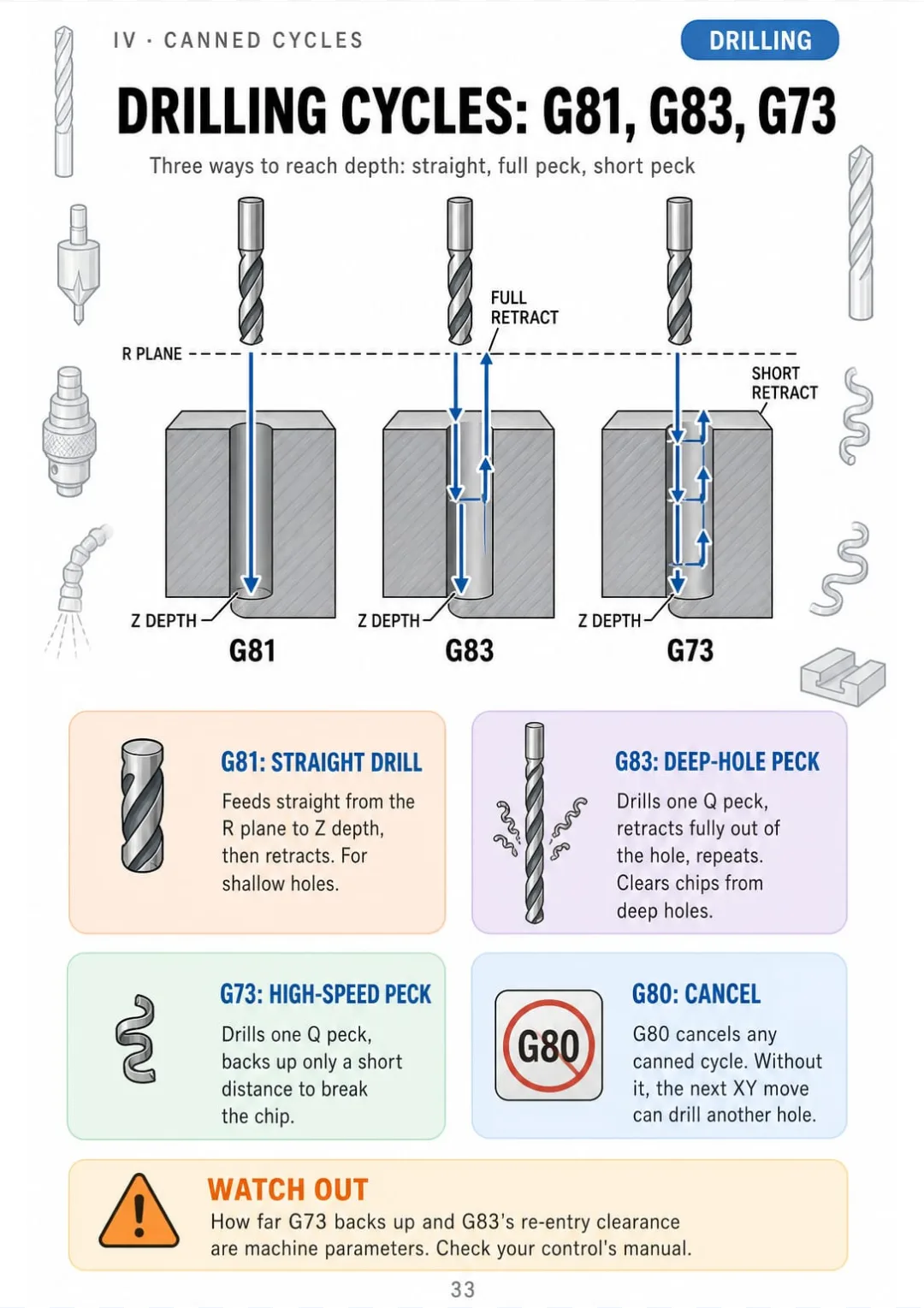
G81 straight, G83 full retract per peck, G73 short retract, G80 cancels.
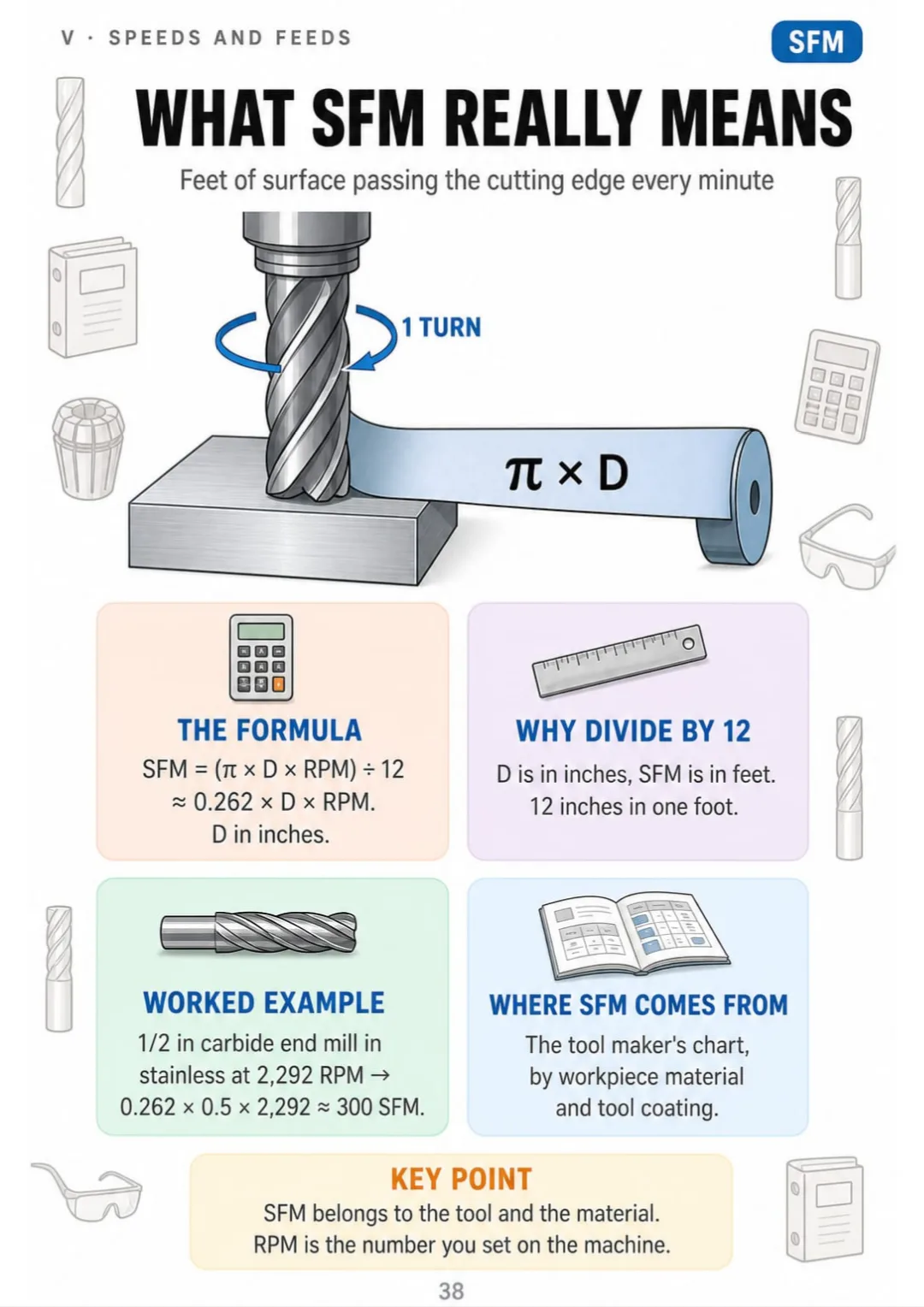
SFM = (π × D × RPM) ÷ 12: the edge speed, drawn as an unrolled ribbon.
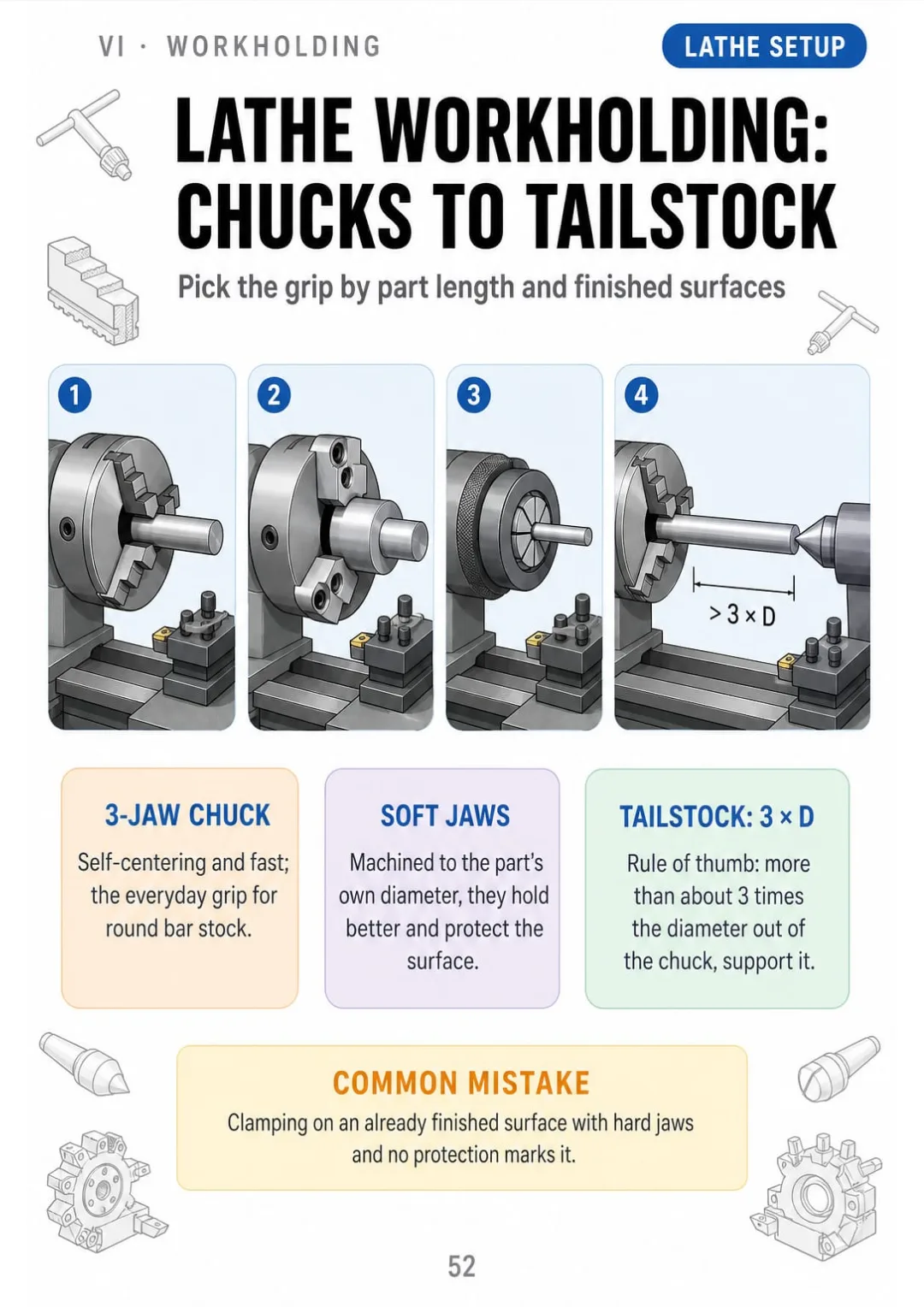
3-jaw chuck, soft jaws, collets, and tailstock support past about 3 × diameter.
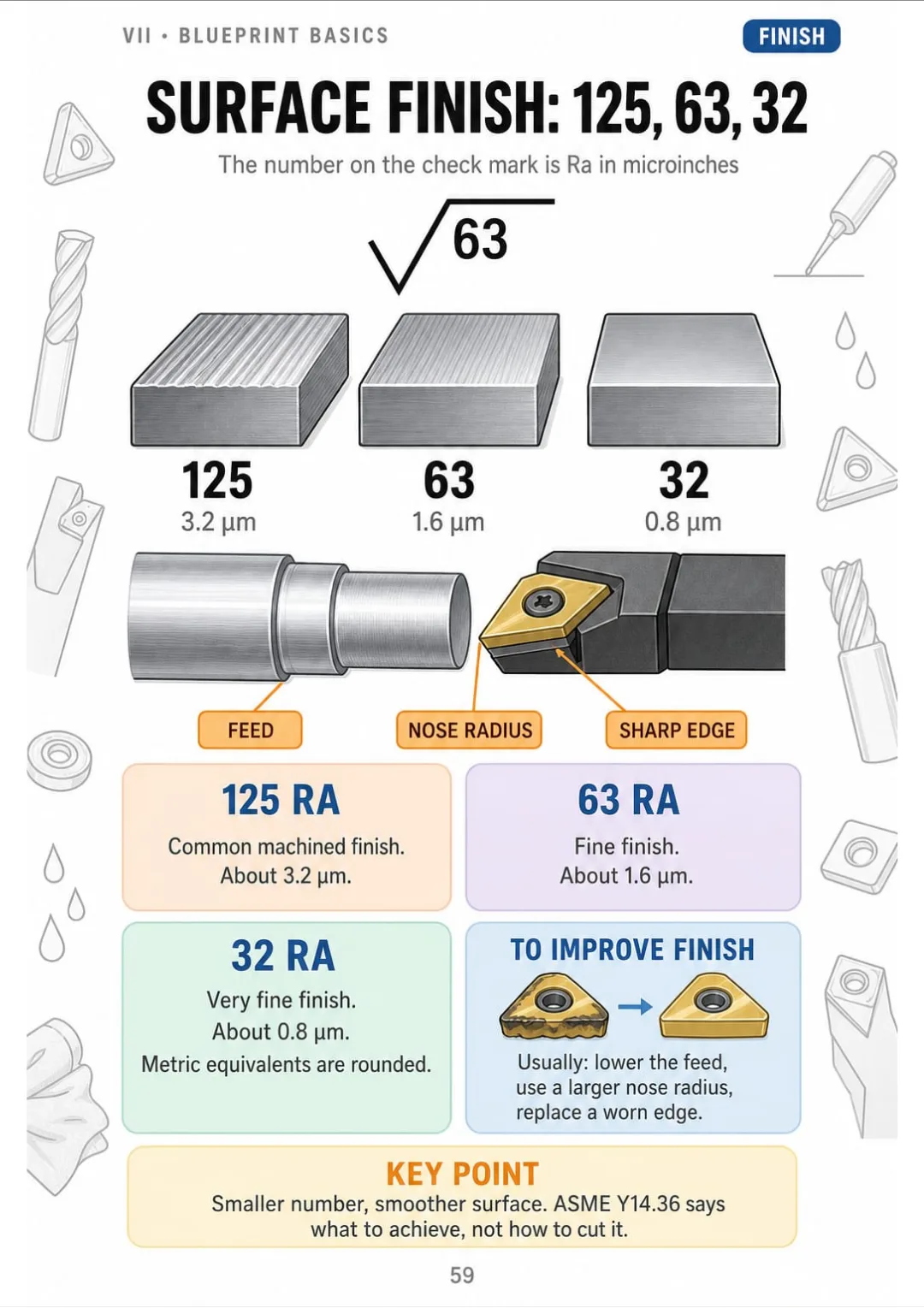
125, 63 and 32 µin Ra (≈3.2, 1.6, 0.8 µm) and the three settings that change finish
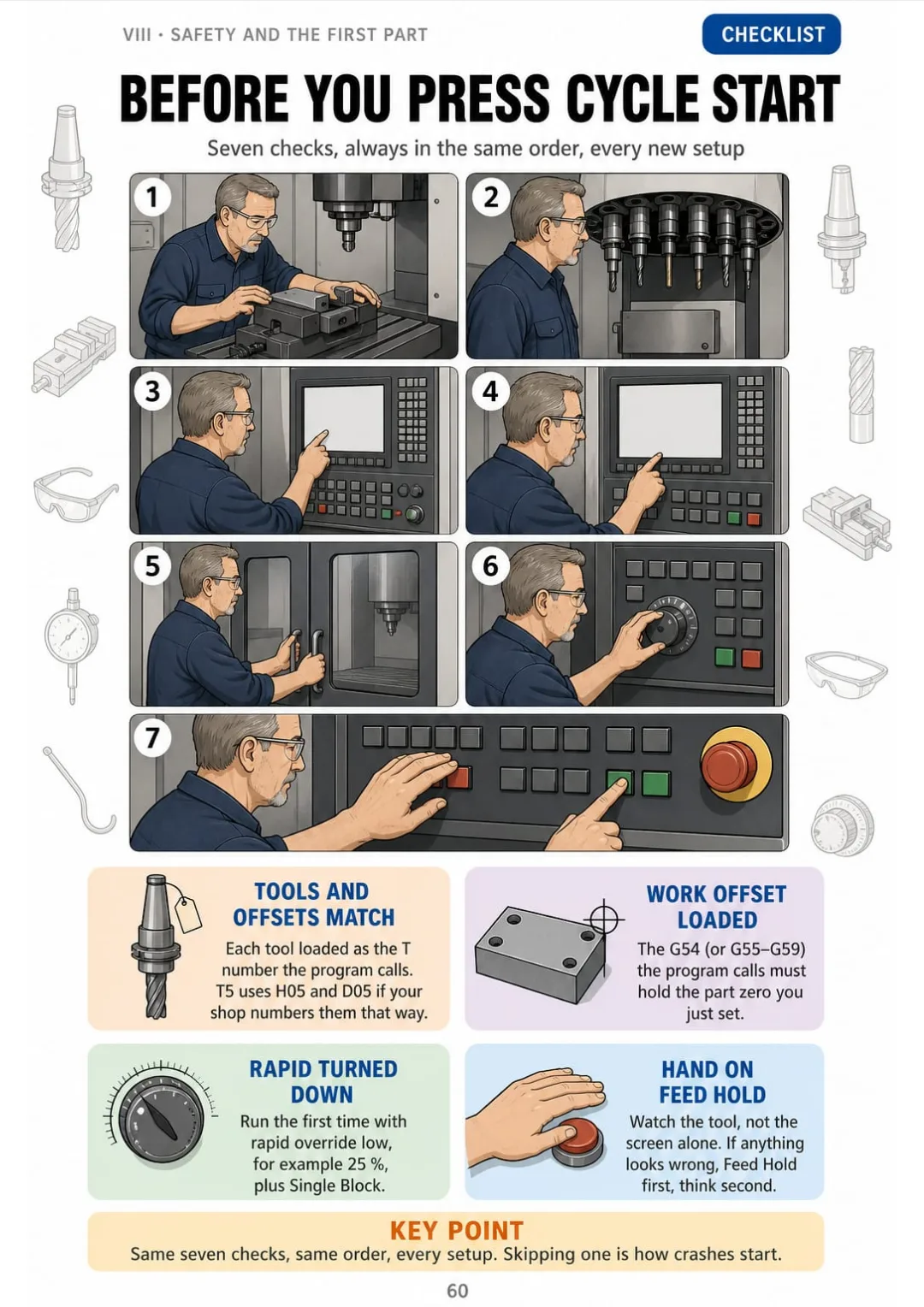
Part clamped, tools, H and D, G54, doors, rapid at 25 %, hand on Feed Hold.

Swipe to see more →

These are real pages from the book. The table of contents is the full one: 9 parts and 64 topics.

The Problem Isn't You. It's How It Was Explained to You.

You're standing at the control with a program on the screen, and the setup guy asks what line N40 is going to do. You see letters and numbers, and nothing tells you where to start.

The control manual covers it in pages of paragraphs: addresses, words, blocks, modal groups. It makes sense at the kitchen table. At the machine, it doesn't connect to anything.

G00 = rapid, may be a dogleg; G01 = straight line at feed F.

In the book, a program is one page: from % to M30, every part labeled, and what N, G, X, F, S, T and M mean, each one next to the line where it shows up.

Same with machine zero vs. work zero, G90 vs. G91, arcs with I and J, and SFM to RPM: each one gets its own page and its own drawing.

Next time someone points at a line, you read it, you know what the machine is about to do, and you don't go back to the manual.

COMPARE FOR YOURSELF

Same Topic, Two Ways to Study It

THIS
  • The manual: line after line of text
  • Edge finding explained in words only
  • You walk up to the machine still unsure
To establish the X and Y work coordinates, the operator shall mount a mechanical edge finder in the spindle and rotate it at a speed generally between 800 and 1,200 RPM. The stylus is then brought into contact with the workpiece reference surface using handwheel increments of decreasing magnitude until the stylus displaces laterally. At that point, the spindle centerline is located at a distance equal to one half of the stylus diameter from the surface, a value that must be accounted for when the position is entered into the applicable work offset register.
FOR THIS
  • The edge finder in one drawing
  • The 0.100 in shift, and which way it goes, in a box
  • You see it and you get it
Edge finder with a 0.200 in tip: the spindle is 0.100 in from the edge when it kicks.
CONTENTS

Take a Look at the 9 Parts and 64 Topics

The machine and its axes, offsets and setup, reading a program, canned cycles, speeds and feeds, tooling and measuring, blueprints, safety and a final review: 68 pages, all illustrated.

IThe Machine and Its Axes · pp. 5-12
  1. Lathe vs. Mill: What Moves
  2. Axis Directions: Which Way Is Plus
  3. The Control Panel and Its Modes
  4. Overrides: Feed, Rapid and Spindle
  5. Machine Zero: Where the Machine Starts Counting
  6. Work Zero: Where You Start Counting
  7. Machine Zero vs. Work Zero on the Same Part
  8. The Position Screens: Which Number to Watch
IIOffsets and Setup · pp. 13-21
  1. Setting X and Y with an Edge Finder
  2. Setting Z on a Mill: Tool Setter, Paper or Block
  3. Tool Length Offset: G43 H
  4. Cutter Radius Compensation: G41, G42, G40
  5. Setting Work Zero on a Lathe
  6. Geometry vs. Wear Offsets
  7. Nose Radius and Tip Direction on the Lathe
  8. Fixing Size on a Mill with Wear
  9. The Safe First Run: Single Block and Dry Run
IIIReading a Program Line by Line · pp. 22-32
  1. Anatomy of a Program
  2. The Safe Start Line
  3. Modal vs. One-Shot Codes
  4. G00 vs. G01: Rapid and Cutting Feed
  5. G90 vs. G91: Absolute and Incremental
  6. Arcs with R: G02 and G03
  7. Arcs with I, J and K
  8. Planes: G17, G18, G19
  9. The M-Codes You See Every Day
  10. Reading a Mill Program, Line by Line
  11. Lathe Speed Codes: G96, G97 and G50
IVCanned Cycles · pp. 33-37
  1. Drilling Cycles: G81, G83 and G73
  2. G98 vs. G99: Where the Tool Returns
  3. Tapping with G84
  4. Lathe Roughing and Finishing: G71 and G70
  5. Subprograms: M98 and M99
VSpeeds and Feeds with Worked Math · pp. 38-46
  1. What SFM Really Means
  2. From SFM to RPM
  3. From Chip Load to IPM
  4. Chip Load: Too Little, Too Much
  5. Lathe Feed: Inches per Revolution
  6. Drilling Speeds and Feeds
  7. Depth of Cut and Stepover
  8. Reading Chips and Sound
  9. Inch and Metric Without Getting Lost
VITooling, Workholding and Measuring · pp. 47-54
  1. End Mills: Flutes, Material and Climb vs. Conventional
  2. Drills, Spot Drills and Taps
  3. Reading a Lathe Insert Code
  4. Toolholders, Collets and Stickout
  5. Squaring the Vise and Using Parallels
  6. Lathe Workholding: Chucks, Soft Jaws and Tailstock
  7. Reading Calipers and Micrometers
  8. Indicators: Dial Test vs. Plunger
VIIBlueprint Basics · pp. 55-59
  1. Title Block and Views
  2. Tolerances: Limits, Bilateral and Title-Block Defaults
  3. Thread and Hole Callouts
  4. GD&T Basics: The Feature Control Frame
  5. Surface Finish Symbols
VIIISafety and the First Part · pp. 60-63
  1. Before You Press Cycle Start
  2. The Most Frequent Crash Causes
  3. Guarding and PPE on the Shop Floor
  4. First-Article Inspection
IXReview and Quick Check · pp. 64-68
  1. The Setup in 8 Steps
  2. Every Formula on One Page
  3. The Codes on One Page
  4. Frequent Mistakes and How to Catch Them
  5. Self-Check: 10 Questions with Answers

One Page, One Topic, All Clear

Think of it this way:

The vise is squared and the part is clamped. Now you need work zero, and the lead is busy on another machine.

You open the book to the edge finder page. The 0.200" tip, the moment it kicks, and the 0.100" that puts the spindle on the edge, all in one drawing, plus where that number goes in G54.

SFM = (π × D × RPM) ÷ 12: the edge speed, drawn as an unrolled ribbon.

Same with tool length offsets, geometry vs. wear, G81 vs. G83, and chip load to IPM: each one on its own page.

CNC Machining Illustrated is 9 parts and 64 topics, all drawn, and at the end the setup in 8 steps, every formula and code on one page, and 10 self-check questions with answers.

What you see drawn, you don't have to memorize.

What's Inside CNC Machining Illustrated:

Ipp. 5-12

The Machine and Its Axes

Lathe vs. mill, which way is plus on each axis, control modes, overrides, and machine zero vs. work zero on the same part.

IIpp. 13-21

Offsets and Setup

Edge finder, setting Z, tool length offset G43 H, cutter comp G41/G42/G40, lathe work zero, geometry vs. wear, and the safe first run.

IIIpp. 22-32

Reading a Program Line by Line

Anatomy of a program, the safe start line, modal codes, G00 vs. G01, G90 vs. G91, arcs with R and I/J/K, planes, M-codes and lathe speed codes.

IVpp. 33-37

Canned Cycles

Drilling with G81, G83 and G73, G98 vs. G99, tapping with G84, lathe roughing with G71 and G70, and subprograms.

Vpp. 38-46

Speeds and Feeds with Worked Math

SFM, SFM to RPM, chip load to IPM, lathe feed per revolution, drilling, depth of cut and stepover, reading chips, inch and metric.

VIpp. 47-54

Tooling, Workholding and Measuring

End mills and cut direction, drills and taps, lathe insert codes, holders and stickout, the vise and parallels, chucks, calipers, mics and indicators.

VIIpp. 55-59

Blueprint Basics

Title block and views, tolerances, thread and hole callouts, the feature control frame and surface finish symbols.

VIIIpp. 60-63

Safety and the First Part

What to check before Cycle Start, the most frequent crash causes, guarding and PPE, and first-article inspection.

IXpp. 64-68

Review and Quick Check

The setup in 8 steps, every formula and every code on one page, frequent mistakes and 10 self-check questions with answers.

At the end of the book: The setup in 8 steps, every formula and code on one page, and 10 self-check questions with answers.

Plus: 2 Free Books

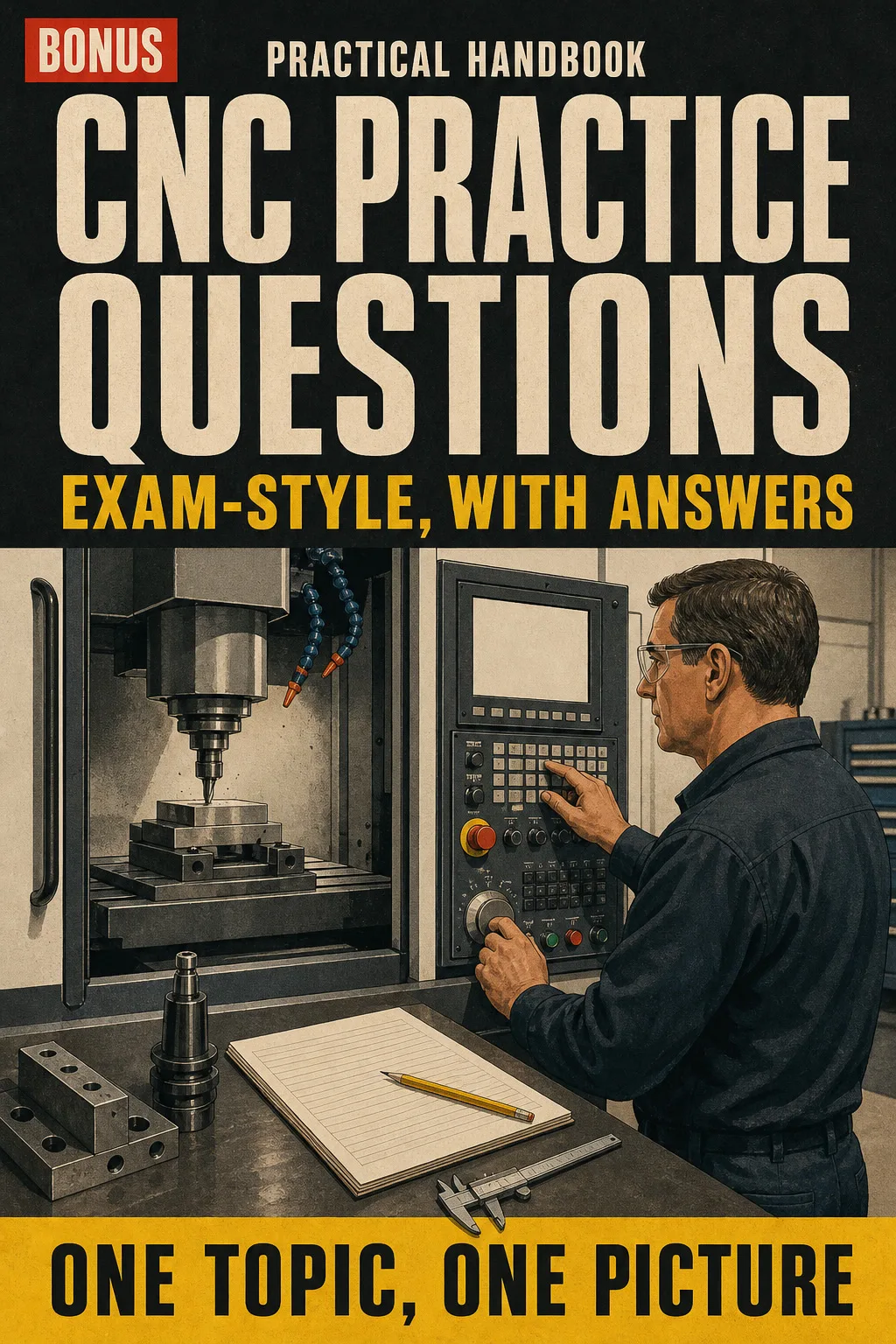
CNC Practice Questions: Exam-Style, with Answers

BONUS 1: «CNC Practice Questions: Exam-Style, with Answers»

Value on its own: US$ 17.90

Test yourself on offsets, G- and M-codes, arcs and speeds-and-feeds math, with every answer worked out step by step so you can see where you went wrong.

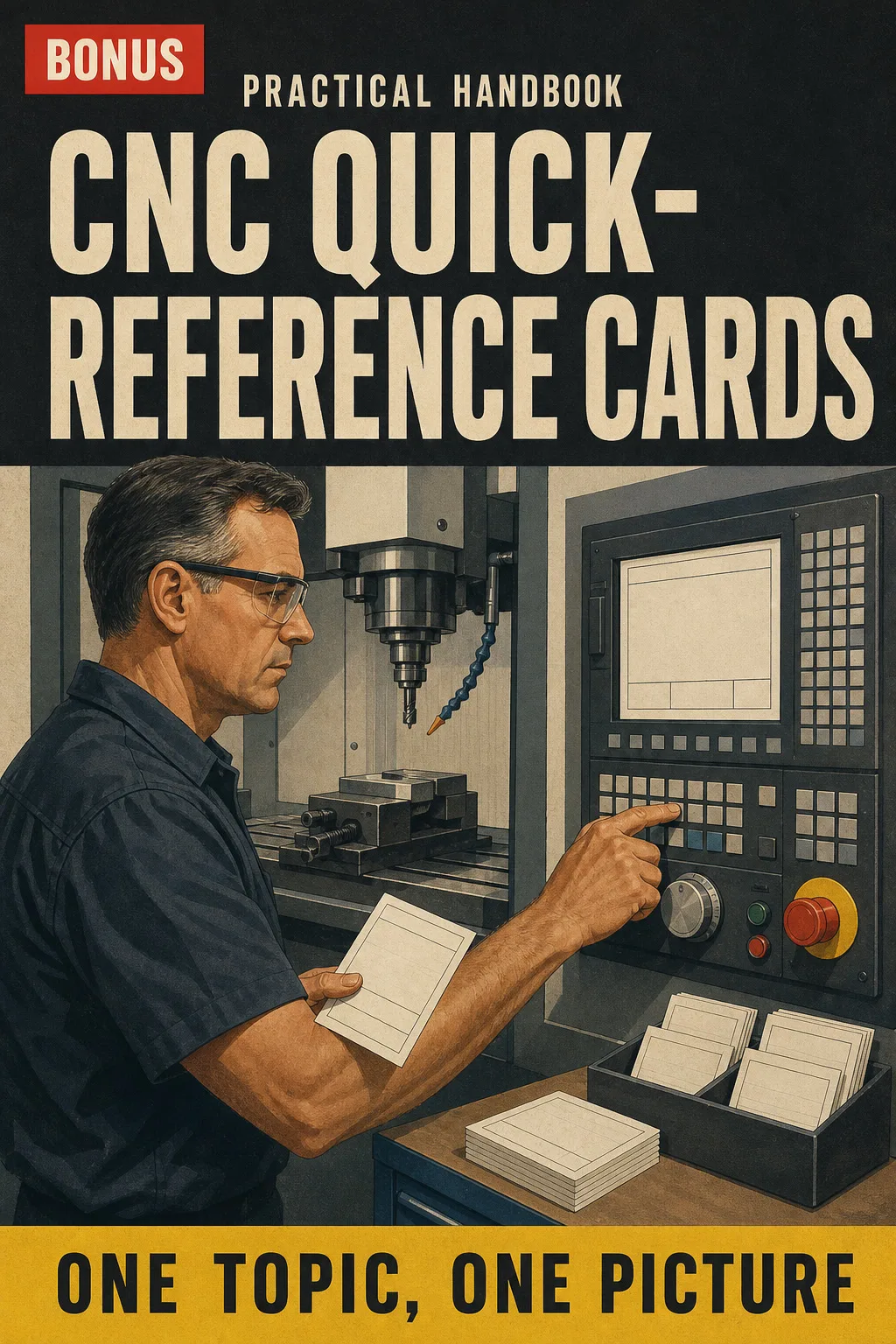
CNC Quick-Reference Cards

BONUS 2: «CNC Quick-Reference Cards»

Value on its own: US$ 14.90

The G-codes, M-codes, formulas and the most common setup mistakes on printable cards you can keep at the machine and check in a glance.

CNC Machining Illustrated with 2 Free Books

  • CNC Machining Illustrated: 68 illustrated pagesUS$ 63
  • BONUS 1: CNC Practice Questions: Exam-Style, with AnswersUS$ 17.90
  • BONUS 2: CNC Quick-Reference CardsUS$ 14.90
  • High-resolution PDF to printIncluded
Total value US$ 95.80
YOUR PRICE:
US$ 27
You save US$ 68.80
YES, I WANT CNC MACHINING ILLUSTRATED FOR US$ 27

📄 This is a digital PDF book sent to your email: nothing is printed or shipped.

Secure purchaseEncrypted payment30-day guarantee

PDF by email: We email you CNC Machining Illustrated as a PDF, together with the two free books. It's a single payment: no installments, no extra charges.

Who This Book Is For

You're in a machining program

You're in a machining program

Every class topic has its own drawn page: offsets, G-code, speeds and feeds. You review in the same order every time, without digging through the textbook.

Your evaluation or credential is coming up

Your evaluation or credential is coming up

The formulas, the codes and the setup steps are on one page each at the end. You check what you know, and the practice questions show where you went wrong.

You already work in the shop

You already work in the shop

You know how to cut metal. The book shows you where each number lives on the control, so you can take on the setup yourself. Print it and keep it at the machine.

Everything You Get Today

US$ 95.80US$ 27
YES, I WANT CNC MACHINING ILLUSTRATED FOR US$ 27

📄 This is a digital PDF book sent to your email: nothing is printed or shipped.

30DAYS
GUARANTEE

30-Day Guarantee

Try CNC Machining Illustrated for 30 days, bonus books included.

We refund everything if the file won't open, if the book isn't what you see here, if you were charged twice or if the email doesn't arrive. Just email us.

You pay once. No subscriptions.

Frequently Asked Questions

Is it for me if I've been running machines for years?

Yes. It doesn't teach you to cut metal; it shows where things live on a CNC: work zero, offsets, each line of a program, the speeds-and-feeds math. If you're moving from manual or from loading parts to doing setups, that's what it covers.

Where does the content come from?

From ASME Y14.5-2018 for drawings and tolerances, OSHA 29 CFR 1910.212 for machine guarding, and the NIMS Level I skill standards for CNC mill and lathe. The codes follow standard Fanuc-style G-code, and the book points out where controls differ so you check your own control's manual.

Is this official material?

No. It's an independent study book. It isn't issued or endorsed by any credentialing body, agency or machine or control manufacturer, and it doesn't come with a certificate or count toward one.

Does it replace my training program or shop training?

No. It's for studying and reviewing. It doesn't replace your program, your shop's training, OSHA rules or your machine's manual.

Are the practice questions the ones on the exam?

No. They're written for this book, to practice offsets, codes, arcs and speeds-and-feeds math, with every answer worked out. They aren't official questions from any exam or credential.

When and how do I get it?

As a PDF by email, at the address you enter at checkout. The 2 bonus books come with it.

Will it work with the control in my shop?

The codes follow standard Fanuc-style G-code, the kind most CNC mills and lathes in US shops read. Where controls commonly differ, like lathe code groups, peck retract and tapping, the book points it out so you check your own control's manual. Conversational programming isn't covered. One-time payment, no subscription.

Can I have it on paper?

Yes. It's a PDF you can print at home or at a print shop and keep next to the machine.

How does the refund work?

You have 30 days. We refund everything if the file won't open, if the book isn't what you see on this page, if you were charged twice or if the email doesn't arrive: just email us.

Before You Close This Page

No more rereading the control manual with nothing sticking.

Machine zero vs. work zero: you see it drawn and that's it.

You walk up to the machine knowing where every number lives.

Drawings make studying faster.

The book is right below.

One-time payment: US$ 27 · Guarantee: 30 days · PDF by email

YES, I WANT CNC MACHINING ILLUSTRATED FOR US$ 27

📄 This is a digital PDF book sent to your email: nothing is printed or shipped.